Author: daytonheritage
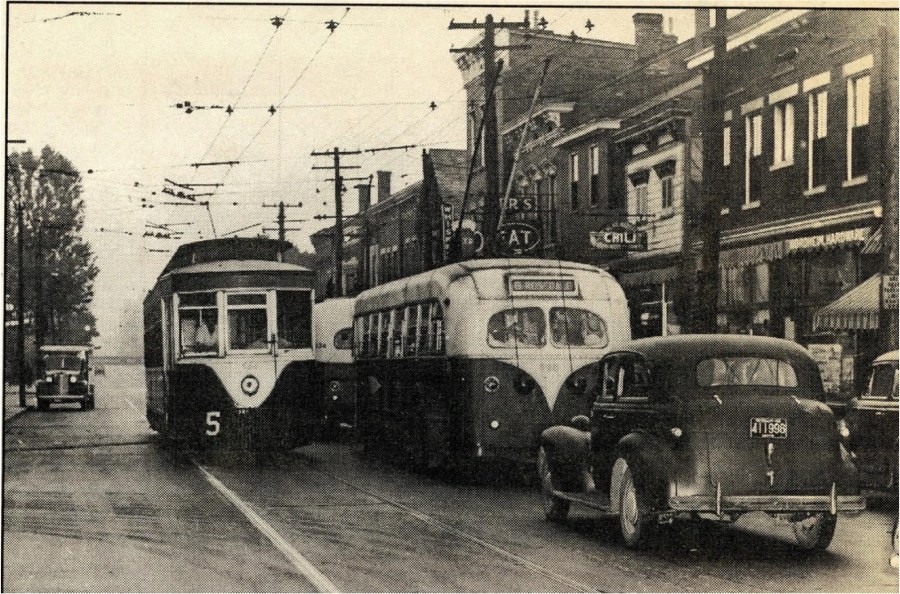
The buzz recently about a streetcar line coming to Northern Kentucky peaked my interest since Tharp Dayton Heritage Museum is featuring transportation during the winter months. Streetcars had been a most efficient means of transportation until the last of the lines closed in 1951. But their demise began with the flood of 1937 and a strike in 1940 by bus and streetcar operators that lasted nearly 6 weeks.
The historic flood of 1937 impacted Northern Kentucky perhaps more than any other area along the Ohio River. Everything came to a halt and moving about freely from cities along the river through to Cincinnati stopped completely, since many streetcar lines submerged under the rising tides, and streetcars had no alternatives to the rails. Several transportation companies had been in operation throughout Campbell and Kenton Counties prior to the flood. The Green Line realized opportunity’s knock after flood waters receded and they began buying bus companies that had operated independently.
By 1939, the Green Line had purchased the last two remaining companies: Dixie Traction operating in Erlanger-Elsmere-Ft. Mitchell and Black Diamond operating in Ft. Thomas-Cold Springs. Rather than assigning the parent company name, Dixie Traction became the name for both lines. Issues arose as discussion began on the demise of the streetcar. It no longer seemed feasible to run passengers who worked in Cincinnati and traveled daily by mass transport via streetcars. The advantage of bus lines opened the area to more commerce along the lines that weren’t tied to a rail system.
The Amalgamated Association of Street, Electric Railway and Motor Coach Operators boasted a membership of 300 Green Line employees. While the Dixie Traction employees had belonged to the Brotherhood of Railway Trainmen. This smaller band of employees worried when the streetcar ceased operation that they would be out of a job, due to the fact that the employees of the Green Line had seniority. A strike on December fifth, 1940 could not be avoided. And what was thought to be a days’ long strike turned into 6 weeks of traffic jams along Route 8 as cars bottle-necked the bridge entrances.
The Christmas season usually meant more shoppers on buses going back and forth between Dayton, Newport and Cincinnati. However, local businesses benefited from the lack of mass transportation.
The Kentucky Times-Star interviewed William Seiger, pilot of the Dayton Ferry due to the fact that he had seen the need to provide an alternative to the jammed route by car. He began his runs at 6:00 a.m. not stopping until midnight and made more than 4400 three-minute trips across the Ohio by the time the strike ended. A Mrs. Schwarberg of Fort Thomas, a passenger on the ferry, along with her mother, Grace Held of Dayton and her 4-month-old son, said that riding the ferry was exciting and brought back memories of her youth.
By January 6, 1941, Dayton became the first city to start its own emergency bus service. Four buses, one seating 50 and the other three seating 35, began operating first between Dayton and Covington and then to Cincinnati. To avoid problems with strikers, the buses made no stops between Dayton and Cincinnati once that service began. Strikers with baseball bats dotted the route on Fairfield and Sixth Avenues, trying to thwart any transportation in to Cincinnati.
As the strike drug on, interested parties were ordered to appear before a judge who called the strike, “Too much baloney and hot air.” He ordered a settlement which took a bit longer to come to, however, when the strike was settled and the operators went back to work, the Dixie Traction Company employees enjoyed a security that their jobs would be there in the coming years. The streetcar would serve Northern Kentucky and the city of Dayton for ten more years before buses and cars populated the concrete streets that covered the old rails.
Dayton’s Favorite Son, John Wooden
March, it’s that time of year when college basketball overtakes the fans and incites a sort of madness. Brackets, home teams, territorial colors all matter in a month consumed in jump shots, full court presses and unadulterated joy on the faces of ball players who somehow pull out wins against giants. Fans bleed blue, growl like a bearcat, and this year maybe where a darker shade of navy and root for the Xavier Musketeers. The madness got me to thinking about a man we consider a favorite son in Dayton, Kentucky—John Wooden.
In 2004, with Steve Jamison, Mr. Wooden wrote a book entitled: My Personal Best. He says in this autobiographical, motivational book that, “I believe that in my first year at Dayton High School I learned more about how to work with people and about myself—my temper, stubbornness, impatience, and desire for immediate results—than any of the 39 years of coaching to follow.” That first season—1932 to 1933, “Johnny” Wooden led Dayton to a disappointing six wins and eleven losses. The following year the Green Devils recorded fifteen wins and only three losses, and Mr. Wooden’s coaching was hailed “tip top” in the Dayton Pilot, the school newspaper.

Pictured above is the house that John and his new bride, Nellie rented when they came to Dayton. In this modest home he must have expressed his frustration to his high school sweetheart many times in that first year. He’d accepted the job with only $2.00 to his name. The bank that held his life savings—$909.25—had failed just days before they were to leave their hometown of Martinsville, Indiana for the rolling hills and fast currents of Kentucky.
Mr. Wooden wore many hats in his time at Dayton. He had been hired to teach English with a yearly salary of $1500. Named as athletic director, coaching football, baseball and basketball, he received compensation of $300. He said once that he felt overpaid as a coach, especially after an incident with a football player that had digressed into a fist fight. He took courage though, and remembered a favorite quote by Abraham Lincoln, “There is nothing stronger than gentleness.” John quickly
learned his limitations and never coached football again.
In his first year as basketball coach, the Dayton Green Devils traveled to Martinsville, Indiana to face the Martinsville
Artesians, a team for which he had played and been All State. Before a packed gymnasium the Green Devils lost 2′]-1′] and the drive back to Kentucky became very long. He said the lesson learned in that first year as coach came down to the fact that patience is the most valuable asset for a leader. He came to understand that a strong foundation builds a strong and winning team.
So as we turn our attention toward the Final Four, Dayton residents can view the game with a keener eye toward our past. There in that small house heading up the hill, John Wooden must have mulled over strategies in a dim kitchen light while his wife Nellie cooked and encouraged him to be the man he would become, one of the winningest coaches in the game of basketball, coaching the likes of Kareem Abdul Jabir, Magic Johnson and Bill Walton. Kentucky is a long way from Southern California, but I don’t think John Wooden ever forgot the little town that gave him such a strong start to a successful career.

Did his mother call him Eddie? That sleepy-eyed boy who ran the river bank and grew up with three sisters on Second Street in Dayton, Kentucky. He might have been just another factory worker had he not decided to enlist in the Marines. December along the Ohio can make a man want to be anywhere but there when the bitter wind needles the soft skin on one’s face. Imagine that boy, 21 years old and listening to the news on WLW radio, December 7, 1941. The Japanese just bombed Pearl Harbor and Eddie might have given a side glance to see his father’s worried brow. Did Eddie decide that day or December eighth or did he wait until just before he went to the recruiting office on December twelfth? Maybe he talked in hushed tones to his father—Albert, not wanting to upset his mother—Marie, who wiped her hands on her apron not because they were wet but because that’s what she did when worry got the best of her.
Whenever it happened, Edward H. Ahrens from that river town in Kentucky entered basic training on February 3, 1942. What did they see in him to sign him on to the Raiders, an elite team of special forces that were the first responders? Did Eddie show strength that comes from tugging steamboat ropes along the bank, or did he have razor sharp aim from throwing rocks at snapping turtles. We will never know, but what we do know is that he landed with Company ‘A’ at Tulagi, Guadalcanal, in the Solomon Islands on August 7, 1942. He was ready. Reports had come in that the Japanese were on the offensive and that Company ‘C’ had realized a fair amount of deaths and injuries as the first wave to hit the beach.
Here’s how Eddie’s first and last night on that island went as reported by his commanding officer who found Ahrens on August 8.
That evening, Company ‘A’ took positions for the night west of a cricket ground on the island, as part of the defensive line extending along the ridge. The Japanese later launched a fierce nocturnal counterattack which drove a wedge between the two Raider companies. Isolating the latter near the beachhead, the enemy concentrated its efforts on Company ‘A’ in an attempt to sweep up the ridge toward the residency, a former British government building serving as a Raider battalion command post. The Raiders, however, stood firm.
During the savage battle that ensued, Ahrens, in a security detachment assigned the task of protecting the Raiders’ right flank, singlehandedly engaged a group of Japanese in hand-to-hand combat as they attempted to infiltrate the Raiders’ rear. Although painfully wounded in the groin, the gallant young marine killed as many as 13 Japanese (including the unit’s senior officer) and aided materially in stopping their infiltration.
When he was found, mortally wounded he whispered into his buddy’s ear, “I guess they didn’t know I was a Marine.” Edward Henry Ahrens, far from the sound of a calliope, or the smell of catfish frying on a hot summer day, lost his life, gained hero status and ultimately had a ship named for him: the USS Ahrens, commissioned in December, 1943 while his mother looked on. She held in her hand the Navy Cross and a piece of paper—a certificate of the Presidential Unit Citation earned by the first Marine Division. The ship bearing the name of a dreamy boy from Dayton, Kentucky went on to troll the oceans, serving to protect U.S. shores.
Heroism can be defined in many ways, but I like to think that the best definition is a common man or woman performing uncommon acts in an effort to save others. Eddie Ahrens, who grew up in a blue collar family, with little more ambition than to serve his country, fought a battle unlike many other soldiers. My guess is that if he had survived that attack and come back to Dayton, that he would not have spoken about it.
For PFC Ahrens and all of the fallen soldiers in all of the wars our country has fought, we must have the utmost respect.
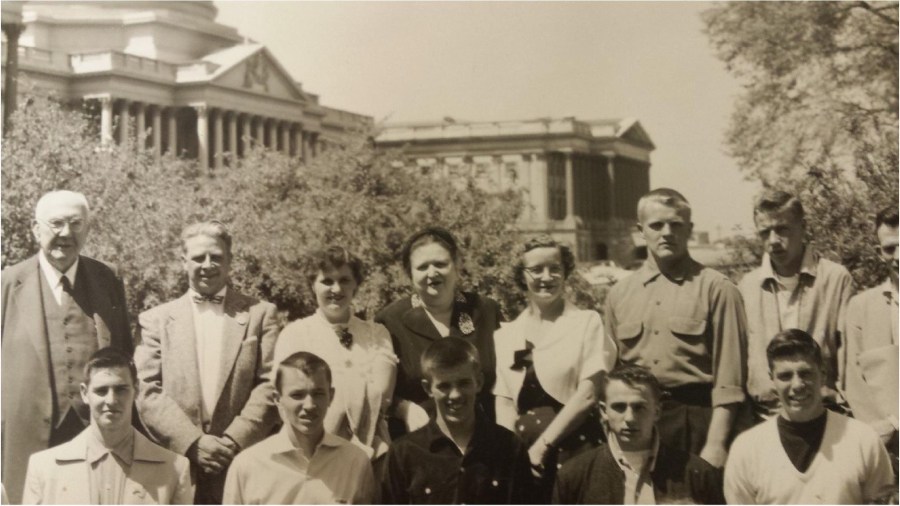 On a recent work day at the museum, I came across a picture of the Dayton High School Senior Class of 1955. The nation’s Capital Building served as the backdrop to young women in skirts and bright smiles, and young men wearing button up shirts, conveying a sense of conviction. In the last row, standing with other adults is a face I recognize from my past—Mrs. Crail. Suddenly I remembered the sewing machine, the building at 511 Sixth Avenue, and a Butterick Skirt Pattern bought at the Dime Store, along with bright, orange flowered material for my first project. As a kid I knew nothing of what it took to organize sewing lessons or any of the other offerings at the Community Action Commission. I just wanted to learn to sew.
The summer sewing lessons shared space with other classes offered. The building had no air conditioning, one phone line, a desk and a window on the street where Mrs. Crail could observe the comings and goings of the city she loved. She had seen a great deal by then, her husband died in 1954, her children graduated from Dayton High School throughout the 1950s and she was a single woman in a culture of families with two parents.
Shortly before President Kennedy was assassinated in 1963 he asked his economic advisors to draw up some proposals to address the problem of American poverty. President Lyndon Johnson, to honor the dead president’s request, in 1966 announced a “War on Poverty.” He expanded and revised the proposals given to Kennedy and developed the Economic Opportunity Act of 1964. The act included such things as Head Start, Job Corps, VISTA (Volunteers in Service to America) and many more. Sara Crail heard the call in Dayton, Kentucky and became the first director of the Community Action Commission in Dayton. To hear her family members tell it, she was very excited to accept the position.
As I stare at the photo of her from 1954, I remember those sewing lessons. But more importantly I remember the woman. Mrs. Crail lived down the street from my house. Her family ties to Cal’s Steakhouse ran deep and members of Cal’s family lived in the 3 story brick that must be one of the oldest homes on the street.
She turned the corner at Dayton Street always seeming to be lost in thought. Perhaps she thought about the people who came to her for food, with no money and no way to make it. Maybe she tried to solve the issue of helping people to buy homes. Or
maybe someone needed job training. Whatever the case, Mrs. Crail was there to help, quietly referring people to food pantries, St. Vincent De Paul, all the while showing a little girl how to lay out a pattern on the grain for an A-line skirt.
Today the issues of poverty still haunt our town, but people like Sara Crail have been there, along the way to offer support and a kind smile. For I think she knew the struggles of common everyday people.
 Coming down the drive, sheltered by tall elms, maples and cottonwoods, a familiar feeling of running barefoot through cool grass came over me. Tree trunks rimmed with mud remind one of a giant straw in a rounded-lip glass. As the breeze off the river graced my face, I could swear I heard an orchestra playing a sultry rendition of a Perry Como song called Surrender. Time seems to have stood still out on Kentucky Route 8.
I’d been invited to lunch at Doyle’s Country Club in Dayton. Two members have been working on an application to put the camp on the National Historic Register and had been to the Tharp Dayton Heritage Museum to research the history of this beautiful sample of what the Dayton riverbank once was. Progress is good, but so is honoring our past. Knowing that a sample of a time gone by could be preserved alongside of Manhattan Harbor and other developments along the Ohio. It gives me hope.
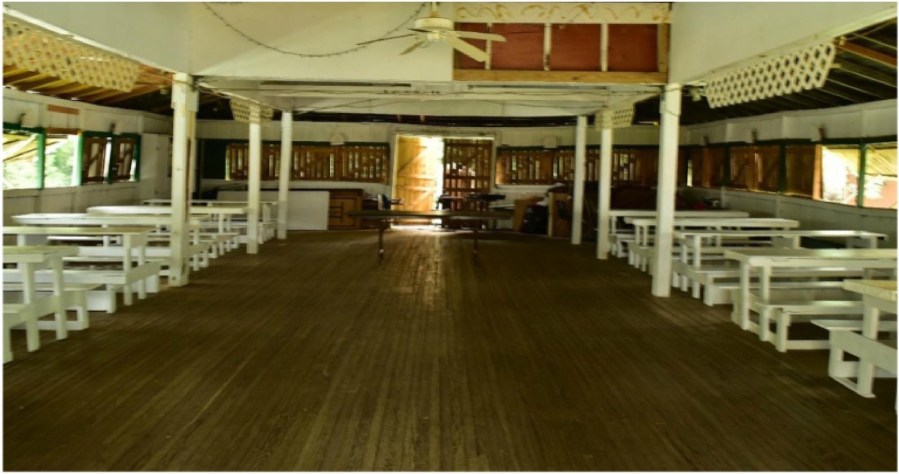
Sixteen cottages line a field that hosts activity during the summer. A pool, a kitchen, and the lower field leads to a beach that remains untouched by development. However, my lunch companions led me to a beautiful structure they call the dance hall. From the outside, it appears to be reclaimed materials, put together to fashion a gathering place. Mounting the steps into the sheltered room, I was transported to a post-World War II era.
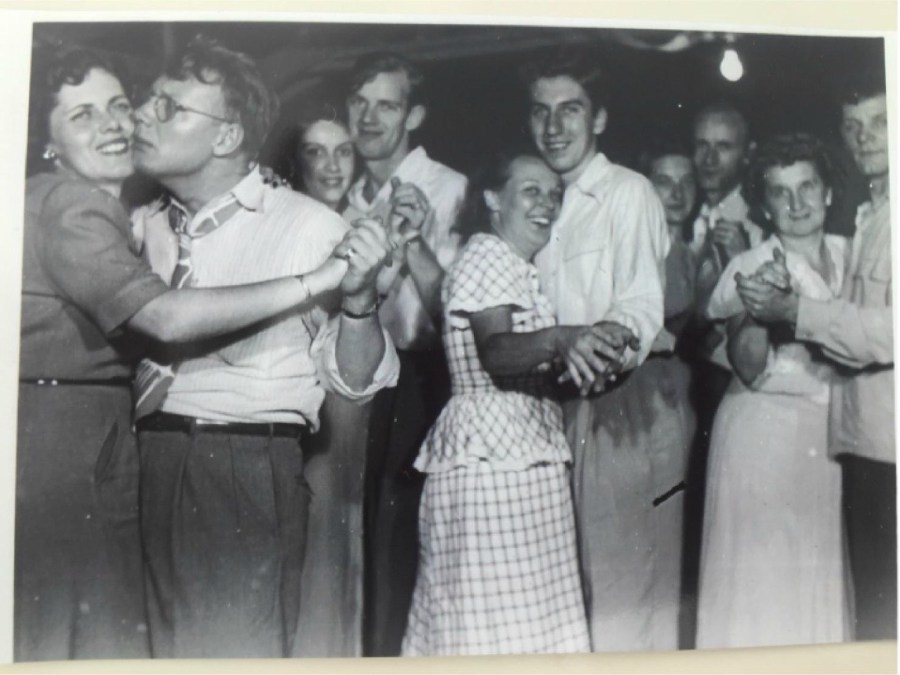
Instantly the ghosts of dancers gripping one another tightly and swirling along a floor that seemed connected to their feet captured my imagination. Moon glow might have illuminated swooping bats among the tall trees that had survived the ’37 flood outside. Shutters would have tilted out to move the still air and cool the brows of heated jitterbuggers. Voices, caught on the breeze off the river could still be heard as an echo of a time that stood still.
Descendants of original members from 1919 still bring their families to Doyle’s every year in those first warm days of spring. It is a microcosm of democracy with its own constitution. Each member family agrees to pay dues and to a substantial investment of sweat equity to keep their summer home in shape. On this particular visit, a storm kept members busy clearing downed branches. Twigs and sticks lying about would become a game for children before two teams of mowers would attack the week’s growth of velvet green lawn that rarely needs more than a summer rain to keep its verdant hue.
Standing in the dance hall, I could still hear the music, only now it sounded more like Nat King Cole singing Unforgettable in every way… . Marcele and Angie, my tour guides, point to small holes in the aged dance floor. I bend to examine them, each one the size of a bore from a carpenter bee. “Do you know what those are?” Marcele asked with a knowing smile. I could have guessed termite drills but had little other ideas and when I looked up, Angie bent to trace her finger close to it and said,
“That’s where flood waters come through to relieve pressure.” Of course, to stabilize the floor, keep it intact rather than a splintered mess, destroyed and floating down river.
The air settled in the hollow building, the caw of a crow outside drew my attention to the opposite end of the building. Sun edged into the space in a romantic sort of way. Was it the shadow of the waving leaves outside the building? It called up the sound of a crescendo of violins, a whispering beat of brush on drum skin, a velvety voice and this picture of couples relaxed into one another, desperate for the summer night to go on forever.
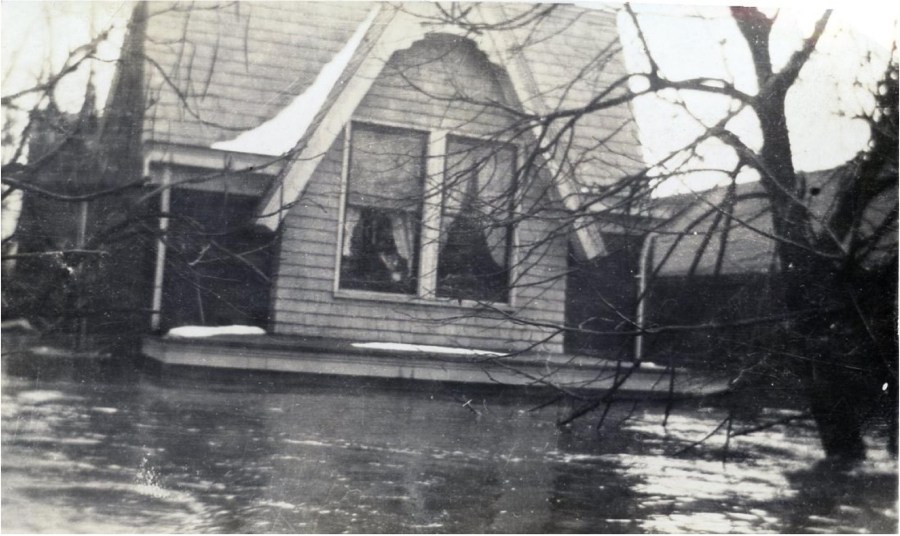 The people who lived in this house at 632 Third Street in Dayton, Kentucky were no strangers to flooding. The Benner family had lived close to the Ohio River all their lives. As the waters crept closer and closer to their home, they moved all their furniture, except for the piano, to the second floor of the house. Before leaving, Elizabeth Benner, the matriarch of the family, put a statue of the Blessed Virgin at the top of the stairs and said to the statue, “Don’t let the water get up here.” The family went back to reclaim their home when the waters receded to find their belongings in tact.
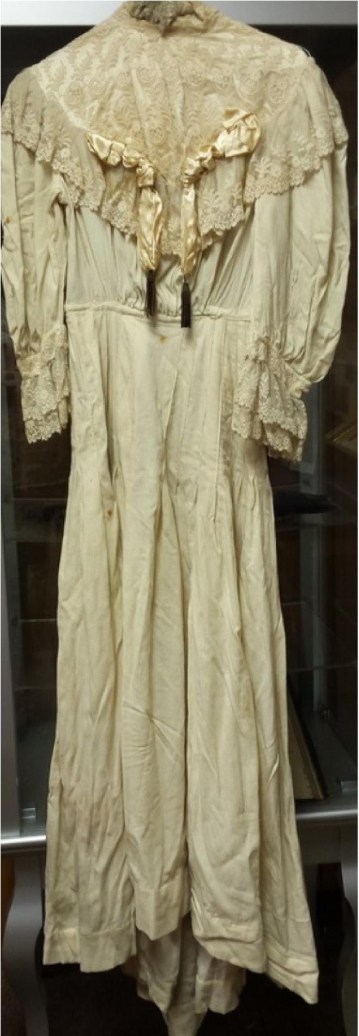 When the new owners of the Prigge home in the 400 block of Sixth Avenue contacted the museum we never expected to learn so much about a family through what remained of their belongings. Walking into the foyer of what once was a very grand home, the place reduced to an organized chaos that testified to the people who had lived their entire lives in that place. Shortwave radios, cases of what appeared to be Mogan David wine, school notebooks handwritten with speculative ideas, table linens, and clothing.
The dress shown in the picture above dates to the late 1800s. It is white broadcloth with satin ribbon adorning the bodice. As I held the dress up against the fine wallpapered foyer of the home, I imagined a small-waisted woman gliding by, the trill of the doorbell provoked by a paper boy spinning the iron lever outside before the grand doorway, his Cincinnati Times Star bag loaded with papers. She likely wore her hair in a loose bun atop her head, ringlets draping down on her well defined neck. These were people of means. Quiet in their resolve, but steadfast in their commitment to the town they lived in.
Among the boxes donated to the museum where photograph albums that appear to be from the thirties, forties and fifties. Each one meticulously labeled with places like Banff in the Canadian Rockies or chairs on a ship sailing the Adirondacks. Don and Violet Prigge appear in the pictures, more Violet than Don. I spoke to members of St. John’s Anglican Church who say that Don economized so much that he came to the church every night to make sure that lights had gotten turned off. And yet, he and Violet traveled the world.
Another box is filled with textbooks, how-to books and lesson books from Sunday School, grade and high school. One such notebook contained this handwritten message from Violet on May 17, 1926:
“Self-reverence, self-control, self-knowledge, these three alone lead life to a sovereign power.” Tennyson. As we grow older we realize more and more that certain actions of ours help or hinder us in our relations with other people. Our parents and teachers are constantly reminding us that we should be polite. Why? Watch the boys and girls who are invariably courteous in everything they do; courteous to elders, to strangers, and to playmates and friends in school and out. Notice the people with whom you are brought in contact; observe how well the courteous person gets along/ and you will surely with to possess that “passport to good society in every country.”
The attic of the house contained a ham radio that Don Prigge built himself. We know that because he kept meticulous notes on how to put it together. He made his own wine, dabbled in chemistry, carpentry, and biology. Mike Lenz, who knew Don fairly well, said that at one point in time, their house had more than just the attic with a dormer that exists today. There had been a fire that destroyed the second floor. I just wonder how much Don or his father had to do with the ingenuity that went into rebuilding. Perhaps that contributed to the reasons why they saved everything.
The new owners told me that they will never have to buy toilet paper, paper towels or garbage bags because Don and Violet had left a healthy store of all three. We are eternally grateful to the new residents of this treasured home for their generosity. This donation is already educating us on what life was like in the early twentieth century in Dayton, Kentucky.
 Dayton Heritage Museum