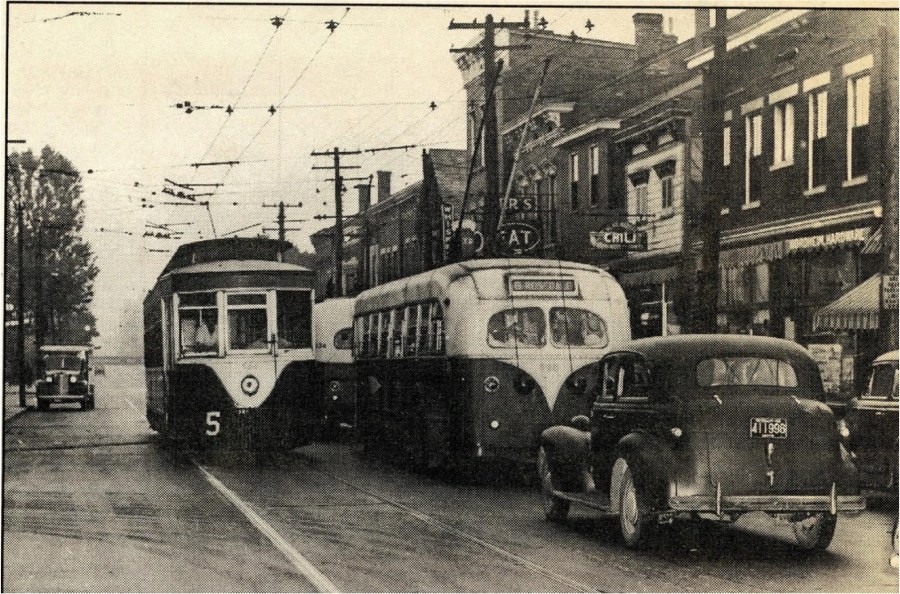
The buzz recently about a streetcar line coming to Northern Kentucky peaked my interest since Tharp Dayton Heritage Museum is featuring transportation during the winter months. Streetcars had been a most efficient means of transportation until the last of the lines closed in 1951. But their demise began with the flood of 1937 and a strike in 1940 by bus and streetcar operators that lasted nearly 6 weeks.
The historic flood of 1937 impacted Northern Kentucky perhaps more than any other area along the Ohio River. Everything came to a halt and moving about freely from cities along the river through to Cincinnati stopped completely, since many streetcar lines submerged under the rising tides, and streetcars had no alternatives to the rails. Several transportation companies had been in operation throughout Campbell and Kenton Counties prior to the flood. The Green Line realized opportunity’s knock after flood waters receded and they began buying bus companies that had operated independently.
By 1939, the Green Line had purchased the last two remaining companies: Dixie Traction operating in Erlanger-Elsmere-Ft. Mitchell and Black Diamond operating in Ft. Thomas-Cold Springs. Rather than assigning the parent company name, Dixie Traction became the name for both lines. Issues arose as discussion began on the demise of the streetcar. It no longer seemed feasible to run passengers who worked in Cincinnati and traveled daily by mass transport via streetcars. The advantage of bus lines opened the area to more commerce along the lines that weren’t tied to a rail system.
The Amalgamated Association of Street, Electric Railway and Motor Coach Operators boasted a membership of 300 Green Line employees. While the Dixie Traction employees had belonged to the Brotherhood of Railway Trainmen. This smaller band of employees worried when the streetcar ceased operation that they would be out of a job, due to the fact that the employees of the Green Line had seniority. A strike on December fifth, 1940 could not be avoided. And what was thought to be a days’ long strike turned into 6 weeks of traffic jams along Route 8 as cars bottle-necked the bridge entrances.
The Christmas season usually meant more shoppers on buses going back and forth between Dayton, Newport and Cincinnati. However, local businesses benefited from the lack of mass transportation.
The Kentucky Times-Star interviewed William Seiger, pilot of the Dayton Ferry due to the fact that he had seen the need to provide an alternative to the jammed route by car. He began his runs at 6:00 a.m. not stopping until midnight and made more than 4400 three-minute trips across the Ohio by the time the strike ended. A Mrs. Schwarberg of Fort Thomas, a passenger on the ferry, along with her mother, Grace Held of Dayton and her 4-month-old son, said that riding the ferry was exciting and brought back memories of her youth.
By January 6, 1941, Dayton became the first city to start its own emergency bus service. Four buses, one seating 50 and the other three seating 35, began operating first between Dayton and Covington and then to Cincinnati. To avoid problems with strikers, the buses made no stops between Dayton and Cincinnati once that service began. Strikers with baseball bats dotted the route on Fairfield and Sixth Avenues, trying to thwart any transportation in to Cincinnati.
As the strike drug on, interested parties were ordered to appear before a judge who called the strike, “Too much baloney and hot air.” He ordered a settlement which took a bit longer to come to, however, when the strike was settled and the operators went back to work, the Dixie Traction Company employees enjoyed a security that their jobs would be there in the coming years. The streetcar would serve Northern Kentucky and the city of Dayton for ten more years before buses and cars populated the concrete streets that covered the old rails.

 Dayton Heritage Museum