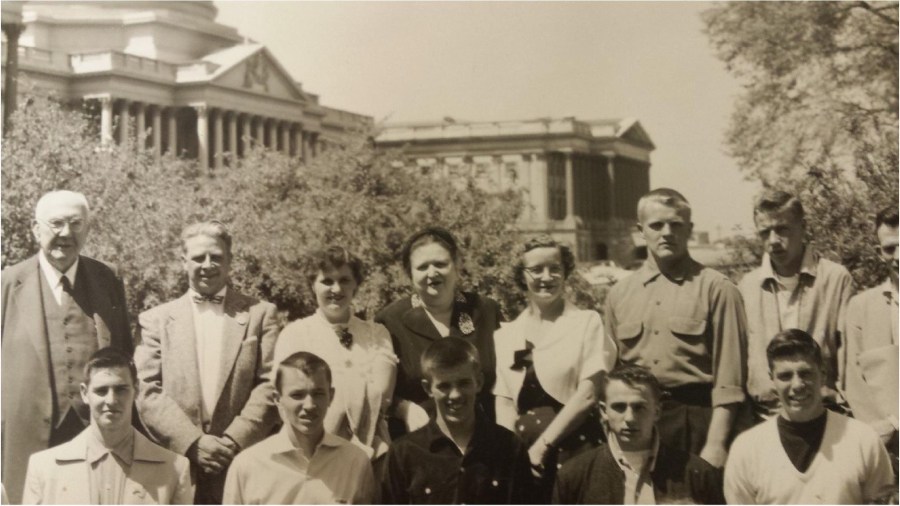
 On a recent work day at the museum, I came across a picture of the Dayton High School Senior Class of 1955. The nation’s Capital Building served as the backdrop to young women in skirts and bright smiles, and young men wearing button up shirts, conveying a sense of conviction. In the last row, standing with other adults is a face I recognize from my past—Mrs. Crail. Suddenly I remembered the sewing machine, the building at 511 Sixth Avenue, and a Butterick Skirt Pattern bought at the Dime Store, along with bright, orange flowered material for my first project. As a kid I knew nothing of what it took to organize sewing lessons or any of the other offerings at the Community Action Commission. I just wanted to learn to sew.
The summer sewing lessons shared space with other classes offered. The building had no air conditioning, one phone line, a desk and a window on the street where Mrs. Crail could observe the comings and goings of the city she loved. She had seen a great deal by then, her husband died in 1954, her children graduated from Dayton High School throughout the 1950s and she was a single woman in a culture of families with two parents.
Shortly before President Kennedy was assassinated in 1963 he asked his economic advisors to draw up some proposals to address the problem of American poverty. President Lyndon Johnson, to honor the dead president’s request, in 1966 announced a “War on Poverty.” He expanded and revised the proposals given to Kennedy and developed the Economic Opportunity Act of 1964. The act included such things as Head Start, Job Corps, VISTA (Volunteers in Service to America) and many more. Sara Crail heard the call in Dayton, Kentucky and became the first director of the Community Action Commission in Dayton. To hear her family members tell it, she was very excited to accept the position.
As I stare at the photo of her from 1954, I remember those sewing lessons. But more importantly I remember the woman. Mrs. Crail lived down the street from my house. Her family ties to Cal’s Steakhouse ran deep and members of Cal’s family lived in the 3 story brick that must be one of the oldest homes on the street.
She turned the corner at Dayton Street always seeming to be lost in thought. Perhaps she thought about the people who came to her for food, with no money and no way to make it. Maybe she tried to solve the issue of helping people to buy homes. Or
maybe someone needed job training. Whatever the case, Mrs. Crail was there to help, quietly referring people to food pantries, St. Vincent De Paul, all the while showing a little girl how to lay out a pattern on the grain for an A-line skirt.
Today the issues of poverty still haunt our town, but people like Sara Crail have been there, along the way to offer support and a kind smile. For I think she knew the struggles of common everyday people.

 Dayton Heritage Museum